


Case study·Web app
A real-time text therapy platform, built from scratch.
Kuradash lets a counsellor in private practice work with a client by text, live, with the words appearing as they are typed. Designed, built and branded here - and still being developed.
It started with somebody who could not carry on
A counsellor was leaving one of the big therapy platforms to focus on private practice and had a client in Singapore who wanted to keep working with them. There was no way to do it, we looked!
The platform in question took a cut of counsellor earnings and found the clients for them ... not supportive of private practice at all. Bi-directional chat seemed only available to the IT support realm and counsellors only had messaging bolted onto a booking system, video or were using Whatsapp and the like. None of it specifically for counselling.
With no independent tool being offered for text therapy we decided to make one. Kuradash is our own product rather than a commission, which meant nobody was there to say a thing was too difficult - and everything on it had to be finished properly, because there was no client to hand the awkward parts to. Yes, we spent too much time on getting it just right before we went live but we are so glad we did.
A brand drawn from scratch
The product name AND identity was made alongside the product - in fact, it changed a few times during the product build too. It had to work at the size of an app icon as well as across a marketing site.

- Purple#58496E
- Green#6BB77B
Our website build
The marketing site explains it; the platform behind it does the work. Scroll through, or go and see the real thing.


The marketing site is its own piece of work. A brochure site has to explain a business; this one has to sell a subscription to somebody comparing it against platforms with far bigger budgets, and do it while they are still deciding whether text therapy is a real thing at all.
So the hero does not show a picture of the product - it runs it. The typing preview on the homepage is the live component from the application, working, before anybody signs up for anything. It is the fastest way to explain a feature that a screenshot cannot show.
A closer look
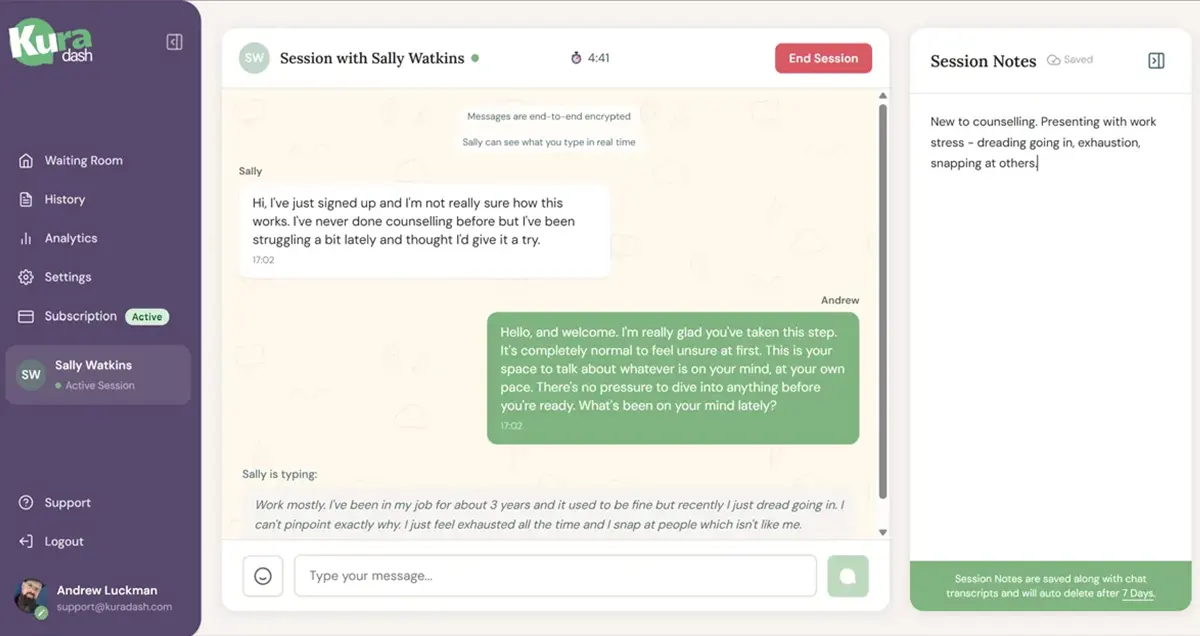
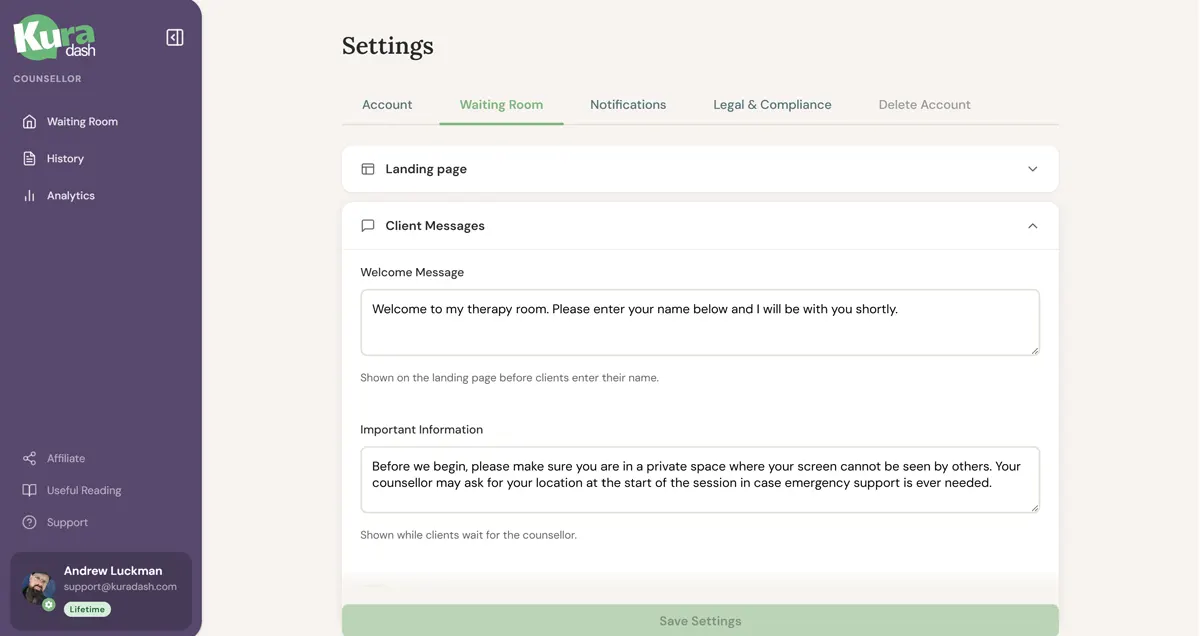
Both sides of the process. A link goes to the client, a session created and the conversation happens in the browser with nothing to install. From any device with an internet browser, for both the counsellor and the client.




Under the bonnet
The hard part of Kuradash is not the chat window, it is everything holding it up. Two people have to see the same conversation at the same instant, on different connections, without a message arriving twice or arriving late - and the client has to be able to join without creating an account, because asking somebody in difficulty to sign up for something may make the process difficult and end the support you are trying to offer.
Messages are end-to-end encrypted in transit and deleted automatically on a schedule, so a counsellor is not quietly accumulating a transcript archive they would have to answer for. They may not even need the transcripts BUT in the event of something concerning being shared, proof is important. A counsellor can export a session and their notes deliberately; nothing is kept by default and should they do that, the GDPR and client privacy responsibility changes to the counsellor.
Around that sits the ordinary unglamorous work that a product needs and a website does not: accounts, subscriptions and billing, an affiliate programme, and organisation seats so a practice can add its own people.
It has been live and looked after since launch, and a running product is a different job from a website - it cannot be down for ten minutes while somebody is in a session.
Built with React, Node, PostgreSQL and Socket.IO.
Text therapy software, built for counsellors
A bi-directional text therapy tool for independent private practice counsellors or counselling organisations. There's no other subscription based product out there for it. It's built from the ground up, with a counsellor on hand for guidance and feature requests. There's no dependencies on third party plugins or developers.
What changed after launch
Shipping it was the start of the work rather than the end of it.
The first version did one job: a counsellor in private practice, working with their own clients, by text, live.
Practices wanted their people on it, so organisation pricing went in - a business can add seats for its own counsellors rather than everyone buying separately.
Writers and counsellors who recommend it can now be paid for it, which needed tracking, attribution and payouts building from nothing.
Got something more complicated than a website?
If you have an idea that requires more than just a website ... chat with us so we can learn more and give you a project pricing ballpark before we drill down on specifics.
 The call is with Andy, the person
who will primarily be working on your project.
More of the work
See all work ›


